Termite Pest Control and Termite Treatment throughout Brisbane and Ipswich
Termite pest control and treatment is essential for every Queensland home. Subterranean Termites have been in the environment for an estimate of some 400 million years. They do one thing and one thing only, break down dead decaying trees in a forest situation to allow new growth.
Why does this have anything to do with your home? Simply because we have a lot of different words (or uses) for a “dead tree”. Top plates, bottom plates, studs, noggins, stringers, bearers, joists, hip beams, skirting boards, door jambs, paper, cardboard, timber flooring… Also known as the necessary components required to make your house a home.
A CSIRO Survey indicates about 1 in 3 dwellings have Termites within the boundary and most homes are at risk. Particularly if well-established gum trees are within 100 meters of the building.
Call John on 0459 238 337 for a Termite Inspection of your place today!
Termite Inspections: Detection and Identification
The Australian Standards A.S.3660.2 is for the detection, prevention and eradication or Subterranean Termites from existing dwellings.
The first and most important aspects of termite pest control according to the Australian Standards Guidelines, is to detect any and all Termite activity within the property grounds. This includes a written and detailed inspection report explaining all areas inspected i.e.
- sub floor
- roof void
- interior
- exterior area
- garden and landscaping
- fences
- other timber structures and
- surrounding trees etc.
The termite inspection report may also include recommendations such as;
- removal of any timber contact with soil
- removing bark gardens against the house
- patio timbers in direct contact with soil
- untreated retaining timbers
- high moisture areas which may require specialist intervention (plumbers) and
- increasing airflow to sub floor areas
The pest control technician will also provide a detailed and comprehensive Treatment Program for your property.

Our Termite Treatment and Eradication Methods
In the event that we do find Termite Infestations at your property, you will be advised to move to our initial termite treatments.
Direct Nest Treatments
There are 4 types of termite nest treatments that termite pest controllers typically encounter:
Ground Mound:
Ground Mound nest treatments are the simplest to treat purely because they are the easiest to identify.
They are also easily controlled by the introduction of either an aqueous or dusting treatment applied directly to the nest.
Arboreal Nest:
Similar to Ground Mounds, Arboreal Nests are easily controlled through the introduction of either an aqueous or dusting treatment applied directly to the nest.
Subterranean Nest:
Subterranean Nests are the most difficult and require the highest level of competency achievable within the industry to detect and treat.
Treatment to the crown root area of a susceptible and active tree requires drilling into the crown root area and flooding using an aqueous solution then resealing the hole.
In the situation of a tree Subterranean Nest (such as under an infill area of a patio, behind timber retaining walls, rock retaining walls etc) it is highly recommended that a baiting system be installed and serviced as per the Australian Standards.
Sub Nest:
Sub Nests are the most disturbing to all home owners as they are found within the house structure itself. Sub nests are highly active and destructive.
Treatment of these nests are managed by the introduction of either a foaming or dusting treatment, applied directly to the Sub Nest and internal workings of the building.
Liquid/Aqueous Treatments
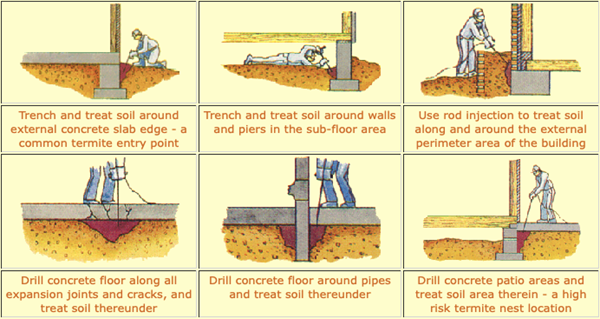
These treatments are where the exterior and sometimes the interior of the structure are chemically treated with a liquid solution against the foundation walls, effectively creating a treated area or zone that abuts the house so as to impede future/further termite attack and damage. This is achieved by drilling holes, at between 150-300mm spacing’s in concrete that is attached the exterior of the dwelling, and trenching all exposed soil areas to the tops of the foundations before applying a registered termiticide at 100l per cubic metre as per A.S.3660.2
There are 2 Liquid Treatments available on the market within Australia.
Repellant Treatment:
This product is designed so that when the Termites, through their tunnelling and scouting activities, encounter the product in the soil attached to the dwelling. They are then repelled by the product with the theory being they do not return to this area. These treatments are by far the cheapest preventative treatment to choose.
Non-Repellant Treatment:
This product, although the more expensive of the choices, is by far the smarter alternative. It works on not just killing the termites that are attacking the house but also works on effectively eradicating the primary nest and colony.
Termite Baiting
Termite Baiting is not new technology. The objective is simple. Install an appealing and easily digestible timber, contained within an approved bait station that is installed directly into the soil, within the first 30 centimetres of the ground at between 4-6 meter intervals around the house structure.
The Termite, in its foraging habits, discovers the timber and starts to consume it making it an easily and readily available high way back to the nest. Once this is achieved the Professional Technician introduces an I.G.R (Insect Growth Regulator) to the active timber resulting in the Termites consuming and sharing the poisonous I.G.R with the rest of the colony, ending with the death of the primary queen and cessation of the nest.
Are Baiting Stations considered to be a successful treatment option?
This is a highly contentious issue within the pest control industry. This is due to the fact that Termites really do randomly forage in search of food, meaning there is no way that you can guarantee that any Termite will find one, let alone all of the Bait Stations places around the property.
We at Xtermin8er Pest Control firmly believe that as an overall Subterranean Termite Treatment Plan that Baiting Stations have their place. This options along with all other treatment options make up part of our unparalleled Subterranean Termite Treatment Procedures. These options will be discussed at length and in detail with our Termite Technicians.
Call us for Termite Treatment of your home or property
Termite pest control services for both residential and commercial properties.
The Different Termite Species Common to Queensland
Coptotermes Acinaciformis:
The Coptotermes Acinaciformis is commonly found throughout Queensland – particularly in urban areas or where eucalypt gum trees are highly prevalent.
Destructive Nature
Coptotermes acinaciformis are highly destructive to buildings and other timber structures. They are the most widely distributed and destructive timber pest in Australia, accounting for more than 70% of the serious damage to buildings in Australia. A single colony may consist of more than one million termites. A most voracious timber pest … one to be taken seriously.
Termite Nest Location
Coptotermes acinaciformis are a very secretive termite species; they build their nest out of sight, often within the base of eucalyptus or other susceptible trees, or completely under the ground; often within an enclosed patio or under concrete on ground flooring which is ideal for moisture retention, temperature and humidity control within the termite colony’s central nest.
Coptotermes acinaciformis can also construct subsidiary termite nests away from the main colony nest. A subsidiary white-ant nest can be contained in a wall cavity of a building where there is a reliable moisture source, for example, from a leaking shower recess or faulty guttering or rusted down pipes.
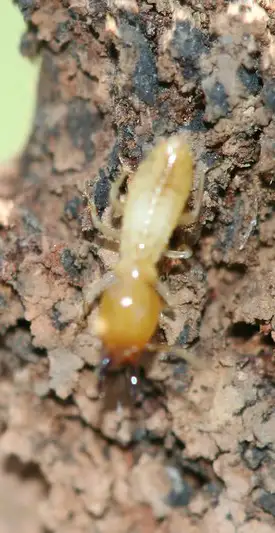
Coptotermes Acinaciformis Termite
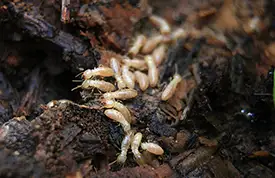
Dampwood Termite:
Dampwood termites form small independent nests which often attack sick or dead trees, decaying stumps or mould timber in the ground; they are seldom found in dry timbers in buildings.
Drywood Termite:
Drywood termites occur mostly in tropical areas, where the atmospheric humidity is constantly above 75 percent. The introduced and highly destructive West Indian drywood termite, Cryptotermes brevis, is rarely located in Queensland. Specialist eradication procedures involve wrapping the entire building in plastic and using methyl bromide fumigation.
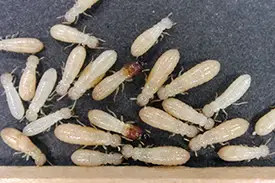
Drywood Termite (Photo Credit: CSIRO)
Heterotermes Ferox Termite:
Area of Distribution
Commonly found throughout Queensland – particularly in urban areas or where eucalypt gum trees are highly prevalent.
Destructive Nature
Heterotermes ferox are destructive to damp timbers and are usually found attacking fences, poles and other timber structures subject to wood decay from weathering or from being in contact with the soil. This species is often confused with the more aggressive and destructive Coptotermes acinaciformis species. Correct identification is essential.
Termite Nest Location
Heterotermes ferox often build their colony nest next to stumps, logs, or other timber in direct contact with the soil where some wood decay or rotting is prevalent.
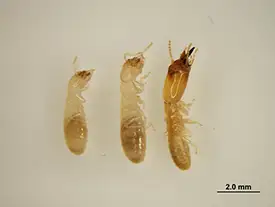
Heterotermes Ferox
Nasutitermes Walkeri Termite:
Area of Distribution
Commonly found in eastern Queensland – particularly prevalent in the coastal and mountain regions along the entire eastern side of Queensland.
Destructive Nature
Nasutitermes walkeri can be destructive to damp timbers often a serious problem where the sub-floor of a building is damp and ventilation is poor with resulting wood decay or fungal growth.ecies. Correct identification is essential.
Termite Nest Location
Nasutitermes walkeri build their nest in trees on the main trunk or in the fork of a large branch.

Schedorhinotermes Intermedius Termite:
Area of Distribution
Commonly found in eastern Queensland – particularly along the entire coast-line, the Great Dividing Range and adjoining slopes.
Identification
This species tends to “gouge” the affected timber and has a fetish around nails used in construction. When you first find them, you will often see a major soldier (6mm in body length) and a minor soldier (4mm in body length).
Destructive Nature
Schedorhinotermes intermedius are highly destructive to buildings and other timber structures. If mostly major (larger) soldiers are sighted, then they will most likely be a large colony with the potential to cause severe and rapid damage to structural timbers of a building or other timber structures.
Termite Nest Location
Schedorhinotermes intermedius commonly build their nest in tree stumps, in the root crown of the living, dead and debilitated trees, under houses or within enclosed patios or other areas where timber has been buried or stored in contact with the soil.
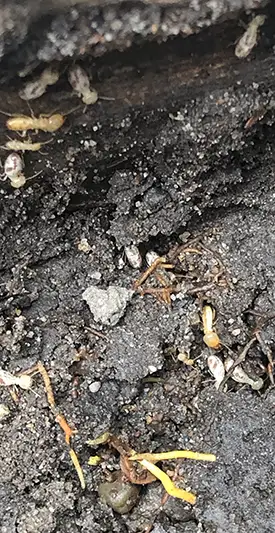
Schedorhinotermes Intermedius Termite